


You probably can’t.
You know the month, the year, the day of the week.
There is a clock on your wall or the dashboard of your car.
You have a schedule, a calendar, a time for dinner or a movie.
Yet all around you, timekeeping is ignored.
Birds are not late. A dog does not check its watch.
Deer do not fret over passing birthdays.
Man alone measures time. Man alone chimes the hour.
Mitch Albom, The Timekeeper

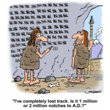
of Calendars
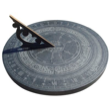
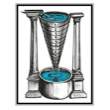
Devices


Scientists speculate that as long as 20,000 years ago, Ice Age hunters made notches on sticks to keep track of time.(1)
Other ancient measurements included the use of terms of "disconnected" or "discontinuous" time—like "twenty snows", "fifty winters", or "[so many] sleeps".
 Some theories suggest that Stonehenge was an ancient timekeeping device akin to sundials, able to track solar and lunar events.(2)
EGYPTIANS
Egyptian calendars initially relied on the cycling of the twelve Decans (constellations). As ancient Egyptians observed these patterns, they believed there existed twelve intervals of darkness and twelve intervals of light. The exact lengths of these periods changed based on the seasons, depending on the time of year. One of the most important events associated with the celestial cycles was the annual heliacal rising of the “Dog Star”, Canis Major (Sirius), which was discovered to rise with the sun every 365 days, and occurred at the same time as the “annual inundation” (flooding) of Nile. Because of the agricultural importance of this event, this became the first month—
 Shadow Sticks, or “gnomons”, were used for timekeeping, and later became the point on the sundial. One of the earliest known shadow sticks is known as the “Thutmosid”, which may be named for Thutmose III (1490-1436 BCE). These devices were used to coordinate activities and public events, for the scheduling shipments of goods, and to regulate planting and harvesting schedules.
It is noted that in equatorial areas, timekeeping was influenced more by lunar events, whereas more northern areas with different agricultural needs depended more on solar cycles.
Ancient Indian people used respirations to note the passage of time:
- One respirations was equal to the “time required to pronounce ten long syllables (
In Puranic (Sanskrit), we see a similar breakdown of the day:
- 15 "twinklings" (
Before 2000 BCE, ancient Babylonians kept a year that consisted of twelve alternating 29-/30-day lunar months, which made up a 354-day year. In Timing the Sun in Egypt and Mesopotamia,(12) John Fermor speculates the possibility that their time units doubled as measures of distance:
- 1 "USH" encompassed four minutes, a word that also meant “length”
 Fermor further references the MUL.APIN—a Chaldaean (7th century BCE) tablet that describes when certain constellations and stars appear.(9) The Chaldaeans also may have been the first to start the 24-hour period at sunrise. Athenians, Jews, Muslims used nychthemeron—meaning, their 24-hour day began at sunset; the Persians 24-hour day started at midnight.(13)
Mesopotamian month names were based on agricultural festivals. Interestingly, there is evidence of time notations for days and years—but not months—which potentially seem to be related to grain and grain product rations. According to R.K. Englund's Administrative Timekeeping in Ancient Mesopotamia, it is possible that the divisions of the day(10) refer to division of the work day, based on 12 hours from sunrise to sunset and the number of workers working number of days (11).
The Mayans (2600 BCE-1500 CE) used observations of the sun and the moon and Venus, and created 260- and 365-day calendars:
“Such observations, simple human acts, fit our understanding of the socioeconomic and religious Maya sphere. The Mayans did not require such an accurate calendar to determine the first day of the rainy season simply for agricultural reasons, but rather for the ceremonial and symbolic significance attached to nature's events.” (p36)
 T-shaped sundials were _____ around 1500 BCE; this may have been the style first used in portable sundials. The T-shaped sundials divided the sunlit day into ten parts, in addition to the "twilight hours" in the morning and evening.(4)
OTHER ANCIENT DEVICES
- The Merkhet (600 BCE):
_______ states that the merkhet “was chiefly a transit instrument and as such is the oldest known astronomical instrument. It was called in Egyptian a mrrk t or merkhet, meaning ‘instrument for knowing,’ to which we should add the word ‘hour.’ As an ‘instrument for knowing the hour’ is of course a timepiece, we may regard merkhet as the earliest known word for ‘clock.' " (p299)

- The “Hemispherical dial”:
Because of the natural limitations of solar-dependent devices, people developed other types of clocks that did not rely on the sun. Sand clocks, or hourglasses, were one example. Other instances included carving evenly dispersed markings on candles or in the reservoirs of oil lamps—the passage of time was noted as they burnt down or changed scent and incense clocks; Anand and Kagali note that “in the Orient, knotted cords and small stone or metal mazes filled with incense that would burn at a certain pace”.(6) Water clocks, or clepsydras (named “water thieves”(7) by the Greeks around 325 BCE), were the most successful and widely used. A clepsydra in its most basic form is a hemispheric vessel with a hole in the bottom that drips water at a constant rate into another vessel below; marks on receiving bowl denote the passage of time as the water rises. In The Beginnings of Time-Measurement and the Origins of Our Calendar, James Henry Breasted speculates that the oldest clepsydra may have been invented around 1550 BCE by Amenemhet, the “earliest known astronomer, physicist and clock maker in the history of science.”(8)
1. James Henry Breasted, “The Beginnings of Time-Measurement and the Origins of Our Calendar,”
The Scientific Monthly 41, no 4 (October 1935): 289. Accessed October 29, 2015, http://www.jstor.org/stable/15981.2. M.Y. Anand and B.A. Kagali, “The Measurement of Time,” Department of Physics, Bangalore University, Bangalore 560056: 279. Accessed November 10, 2015, http://physics.unipune.ernet.in/~phyed/23.4/23.4_Kagal.pdf.
3. Ibid.
4. David A. King, "14th-Century England or 9th-Century Baghdad? New Insights on the Elusive Astronomical Instrument Called Navicula de Venetiis," Centaurus 45, no. 1-4 (January 2003): 204-226, Academic Search Complete, EBSCOhost (accessed October 28, 2015).
5. M.Y. Anand and B.A. Kagali, “The Measurement of Time,” Department of Physics, Bangalore University, Bangalore 560056: 279. Accessed November 10, 2015, http://physics.unipune.ernet.in/~phyed/23.4/23.4_Kagal.pdf.
6. Ibid.
7. James Henry Breasted, “The Beginnings of Time-Measurement and the Origins of Our Calendar,” The Scientific Monthly 41, no 4 (October 1935): 299. Accessed October 29, 2015, http://www.jstor.org/stable/15981.
8. M.Y. Anand and B.A. Kagali, “The Measurement of Time,” Department of Physics, Bangalore University, Bangalore 560056: 280. Accessed November 10, 2015, http://physics.unipune.ernet.in/~phyed/23.4/23.4_Kagal.pdf.
9. John Fermor, "General paper: Timing the sun in Egypt and Mesopotamia," Vistas In Astronomy 41, (January 1, 1997): 157-167, ScienceDirect, EBSCOhost (accessed October 28, 2015).
10. Englund, R. K. "Administrative Timekeeping in Ancient Mesopotamia." Journal of the Economic and Social History of the Orient, 1988., 121:165, JSTOR Journals, EBSCOhost (accessed October 28, 2015).
11. Ibid: 169.
12. John Fermor, "General paper: Timing the sun in Egypt and Mesopotamia," Vistas In Astronomy 41, (January 1, 1997): 157-167, ScienceDirect, EBSCOhost (accessed October 28, 2015).
13. E. Theodossiou, D. Papathanassoglou and V.N. Manimanis, “The Measurement of Small Time Intervals By the Ancient Astronomers,” AIP Conference Proceedings 848, no. 1 (August 25, 2006): 928. Academic Search Complete, EBSCOhost (accessed October 29, 2015).